

Regione header della pagina

Poste Italiane

Your browser version is not updated, please update it.

AI and our commitment

Artificial Intelligence is transforming the way we live, learn, and interact. For Poste Italiane, it represents both a major challenge and an important opportunity to innovate services and improve people’s experiences.
For this reason, we believe that an ethical reflection, interdisciplinary dialogue, and a vision oriented toward the collective well-being are essential to making AI accessible to everyone.

What is our commitment? To integrate the human component throughout the entire lifecycle of artificial intelligence systems. In this way, automation and human responsibility progress in parallel.
Moreover, placing people at the centre means protecting potential vulnerabilities, so that trust becomes the driving force of innovation.
To support this commitment, we are strengthening our AI governance model through the definition of clear rules, responsibilities, and clear processes. When we adopt artificial intelligence solutions, we bring together technical, ethical, and legal expertise to assess AI from a 360-degree perspective.
A central role is played by the AI Committee, a multidisciplinary body responsible for evaluating, approving, and monitoring the use of AI, ensuring that applications are aligned with the Company’s strategic objectives and consistently comply with ethical, regulatory, and legal standards over time.
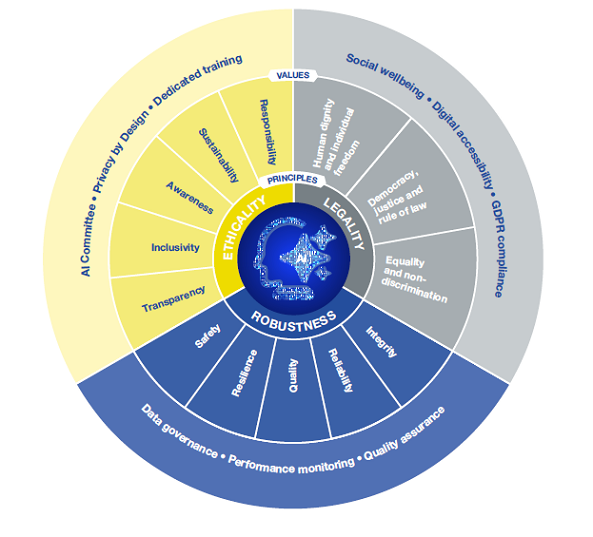
 

Our "Manifesto"
Our approach at Poste Italiane to artificial intelligence means making decisions that affect the entire country.
We foster social cohesion: every innovation we introduce reaches millions of people, families, businesses, and local communities. For this reason, we do not want to limit ourselves to assessing the risks of artificial intelligence, but also to promote its conscious use, supporting the country throughout the technological transition.
In doing so, we have a clear objective in mind: to leave no one behind.
These reflections formed the basis of our ethical "Manifesto", which defines how we intend to design and use AI.

AI according to us: ethics, reliability, legality

Artificial intelligence is part of our everyday lives. It is vital for the technology to be useful and safe, to comply with regulations and ensure fairness. These principles are consistent with our Code of Ethics, the Group Strategy, the Charter of Fundamental Rights and international regulations such as the AI Act, the and the GDPR.
On this basis, our "Manifesto" is built around three essential and balanced components: ethics, reliability, and legality.


Ethics

Our AI upholds the following values:

  • Transparency: we clearly communicate how AI-driven decisions are made.
  • Inclusiveness: we design fair, accessible solutions that respect human diversity. We involve the people most impacted by technology in continuous feedback and control mechanisms and we commit to using data representative of different social groups.
  • Accountability: we ensure that decisions supported by AI remain under the responsibility of competent individuals, with clearly defined roles. Even when automated processes are used, we guarantee human oversight and tools to explain, verify, or correct outcomes.
  • Awareness: we develop AI with constant attention to ethical and social impacts, adopting a privacy-by-design approach and critically reflecting on the consequences of our technological choices.
  • Sustainability: through our technological choices, we aim to contribute to social well-being and the protection of the planet, safeguarding opportunities for future generations.

Each principle corresponds to a clear and specific strategic value:
 
Principles Strategic Values
Transparency We ensure integrity and positive impacts on people.
Inclusiveness We deliver services suited to every need.
Accountability We protect people and communities from unintended effects.
Awareness We foster social cohesion responsibly, without taking anything for granted.
Sustainability We design AI-based solutions to generate shared and lasting value.
 
For us, compliance with these principles is what makes the implementation of AI ethical.

Reliability

Our AI is reliable because it ensures compliance with the following values:

  • Security: our AI systems are designed to protect data, users, and processes, ensuring regulatory compliance and preventing unauthorized access.
  • Resilience: our AI adapts to unexpected problems and situations and withstands attempts at manipulation or unintentional damage.
  • Quality: we rigorously develop and test every model through structured quality assurance processes and continuous performance monitoring, delivering accurate, consistent, and relevant results.
  • Reliability: we ensure stable and predictable performance of our AI solutions, reducing the risk of incorrect behaviour and fostering trust in automation.
  • Integrity: we make our AI transparent and consistent, preserving the correctness of data and decisions. Data quality is managed through a robust data governance framework that ensures traceability, accuracy, and responsible use of information.

For us, compliance with these principles defines a robust AI.

Legality

AI must also be fair. For this reason, we are committed to ensuring that our AI-based systems guarantee:

  • Respect for human dignity and individual freedom: we involve people at every stage of technological development, placing human beings at the center of decisions. We develop systems that protect individuals’ physical and psychological integrity, as well as their personal and cultural identity. We ensure freedom of choice and equal access to the benefits of AI.
  • Democracy, justice, and the rule of law: we believe AI should support democracy and ensure fairness, particularly in public services. We design our solutions to facilitate equitable access to public administration and promote participation in the digital transition.
  • Equality and non-discrimination: we consider it essential to involve everyone, especially vulnerable groups such as minors, minorities, and people with disabilities. We therefore commit to using data representative of different social groups.

For us, compliance with these principles defines fair AI.

Poste and its people: responsible training

We promote a human-centric approach to artificial intelligence through dedicated training initiatives aimed at:

  • Raising awareness of risks related to new technologies.
  • Disseminating the principles that inspire our ethical adoption of AI.
  • Encouraging responsible and conscious use of AI.

Ethical applications: some examples

Ultimately, we translate our principles into concrete actions. Below are some examples:


  • The AI-powered telephone booking service for appointments at post offices complements the booking service already available via App and Web. It is an accessible and inclusive tool, designed especially for people with lower levels of digital literacy.
  • We developed AIKnow, a system that enables interaction with AI to find content supporting Poste’s customer service. We take user feedback into account to ensure transparency and inclusiveness.
  • We also provide support for our logistics network: through the Control Tower project, we optimize routes, distribute loads across vehicles, and calculate saturation rates. This improves supply chain performance, satisfies end customers, and strengthens our commitment to a sustainable future.